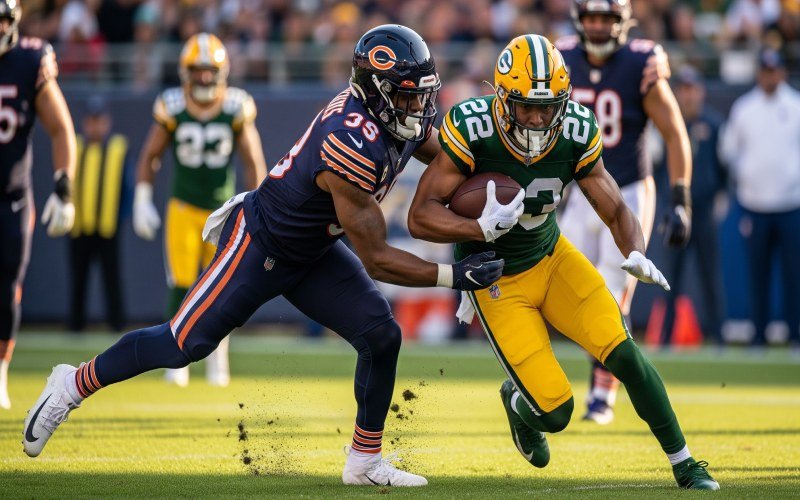
In sports, few rivalries carry as much history and tradition as the Chicago Bears and the Green Bay Packers. With every matchup between these NFC North rivals, fans witness intensity, physical play, strategic battles, and standout individual performances. Their recent major meetings from the 2025 season once again demonstrated why this rivalry remains one of the most respected in the NFL.
Beyond the final score, player statistics help explain how games are won and lost. Quarterback efficiency, rushing production, receiving contributions, defensive stops, and special teams execution all played a role in shaping the outcome. In this article, we will break down the key player performances and statistical highlights from the matchup.
Game Overview
In their recent key 2025 matchup, Green Bay defeated Chicago 28-21 at Lambeau Field.
The stats are as follows:
- Green Bay: 337 total yards
- Chicago: 315 total yards
- Green Bay averaged 6.5 yards per play
- Chicago averaged 4.6 yards per play
These numbers show that while Chicago controlled possession for extended periods, Green Bay generated more explosive offensive plays and made better use of its opportunities.
The game remained competitive throughout, with both teams displaying moments of strong execution. However, Green Bay’s ability to convert key plays into touchdowns ultimately proved to be the deciding factor.
Quarterback Stats
Caleb Williams
Caleb Williams showed flashes of his potential but struggled at times against Green Bay’s defensive pressure.
Passing numbers:
- 19 completions on 35 attempts
- 177 passing yards
- 2 touchdowns
- 1 interception
- 76.6 passer rating
Williams moved the offense effectively during several drives and displayed good decision-making in short and intermediate passing situations. However, Chicago’s passing game lacked explosive downfield production, which limited scoring opportunities.
As a young quarterback, Williams continues to develop and gain valuable experience in high-pressure divisional matchups like this one.
Jordan Love
Jordan Love was one of the most efficient performers of the rivalry game.
Passing numbers:
- 17 completions on 25 attempts
- 220 passing yards
- 3 touchdowns
- 1 interception
- 120.7 passer rating
Love’s deep-ball efficiency helped Green Bay create separation throughout the game. He consistently found open receivers and maximized scoring opportunities whenever Chicago’s defense made mistakes.
His ability to deliver accurate throws under pressure was one of the biggest reasons Green Bay maintained offensive momentum.
Running Back Performance
D’Andre Swift
Swift’s performance provided consistent support for Chicago’s offense.
Statistics:
- 13 carries
- 63 rushing yards
- 4.8 yards per carry
Chicago’s rushing attack remained productive and helped balance the offense. Swift’s ability to gain positive yardage on early downs allowed the Bears to maintain manageable third-down situations throughout portions of the game.
His contribution prevented Green Bay from focusing exclusively on defending the passing game.
Josh Jacobs
Jacobs played an important role on the ground and as a receiver, adding versatility to Green Bay’s offense.
His physical running style helped sustain drives and kept Chicago’s defense engaged throughout the contest.
The Packers finished the game with 117 rushing yards as a team, creating offensive balance and preventing the Bears from concentrating solely on stopping Jordan Love’s passing attack.
The combination of efficient rushing and explosive passing gave Green Bay one of its most balanced offensive performances of the season.
Receiving Leaders
Chicago Bears
D.J. Moore remained one of Chicago’s most dangerous offensive weapons during the rivalry games in 2025.
His performance included:
- 5 receptions
- 97 receiving yards
- 1 touchdown
Moore consistently created separation from defenders and generated several important plays for the Bears. His ability to stretch the field provided much-needed explosiveness to Chicago’s offense.
Whenever the Bears needed a significant gain, Moore was often the primary target.
Green Bay Packers
Jayden Reed and Romeo Doubs were among Green Bay’s biggest receiving contributors.
Jordan Love connected for touchdown passes to:
- Jayden Reed
- Romeo Doubs
- Christian Watson
The Packers’ receiving group demonstrated strong chemistry with their quarterback and capitalized on favorable matchups throughout the game.
Multiple receiving threats made it difficult for Chicago’s defense to focus on a single player, contributing significantly to Green Bay’s offensive success.
Defensive Impact Players
Both teams generated pressure and made important defensive plays throughout the game.
Key defensive statistics included:
- Each team recorded 1 sack
- Each defense forced 1 interception
Chicago’s defense kept the game competitive and prevented Green Bay from completely taking control. Several defensive stops helped keep the score within reach.
However, Green Bay’s secondary delivered critical plays in high-pressure situations, particularly during key passing downs.
Defensive execution often determines the outcome of divisional rivalries, and this matchup was no exception.
Special Teams Performance
Cairo Santos
Santos continued his reputation as a reliable kicker.
Statistics:
- 2/2 field goals
- Longest kick: 41 yards
- 7 total points
His consistency ensured Chicago capitalized on scoring opportunities whenever drives stalled inside Green Bay territory.
Reliable kicking remains an important component of close NFL games.
Brandon McManus
McManus handled his responsibilities efficiently.
Statistics:
- 4/4 extra points
While extra points may appear routine, consistency in special teams often plays a crucial role in maintaining scoreboard pressure throughout a game.
Green Bay benefited from flawless kicking execution.
Key Statistical Difference
Quarterback efficiency was arguably the biggest difference-maker in the game.
| Category | Bears | Packers |
| Passing Yards | 177 | 220 |
| Passing TDs | 2 | 3 |
| Yards per Pass | 4.9 | 8.5 |
| Total Yards | 315 | 337 |
The Packers gained significantly more production from each passing attempt. Their ability to generate explosive plays through the air created scoring opportunities that Chicago struggled to match.
While total yardage remained relatively close, efficiency proved far more important than volume.
Team Comparison Breakdown
Looking beyond individual statistics, both teams displayed different offensive philosophies.
Chicago Bears
Strengths:
- Balanced rushing attack
- Strong effort from D.J. Moore
- Competitive defensive play
Challenges:
- Limited explosive passing plays
- Lower passing efficiency
- Difficulty capitalizing on key opportunities
Green Bay Packers
Strengths:
- Efficient quarterback play
- Multiple receiving threats
- Balanced offensive production
Challenges:
- Occasional turnovers
- Defensive inconsistency during some drives
Overall, Green Bay executed more efficiently in crucial situations.
What This Means for the Rivalry
The Bears-Packers rivalry continues to produce memorable moments and competitive football.
This matchup highlighted several ongoing storylines:
- Jordan Love’s growth as Green Bay’s franchise quarterback
- Caleb Williams’ development as Chicago’s future leader
- The importance of offensive efficiency in modern NFL games
- The continued competitiveness of NFC North divisional battles
Both teams possess talented young players who could shape this rivalry for years to come.
Frequently Asked Questions (FAQs)
Who Had the Better Quarterback Performance?
Jordan Love was the stronger performer during the match, throwing 3 touchdowns while posting a 120.7 passer rating.
His efficiency and ability to generate explosive plays gave Green Bay a significant advantage.
Who Led the Bears Offensively?
Caleb Williams and D.J. Moore were the key offensive contributors for Chicago during their rivalry games in 2025.
Moore provided big-play ability, while Williams managed the offense and delivered two touchdown passes.
What Was the Biggest Statistical Advantage for Green Bay?
Green Bay’s passing efficiency and explosive plays were the biggest differences.
The Packers generated more yardage per pass attempt and converted scoring opportunities more effectively than Chicago.
Conclusion
The Chicago Bears vs Green Bay Packers rivalry remains one of the most historic and entertaining rivalries in professional football. Every meeting between these teams carries significant emotional weight, competitive intensity, and memorable performances.
In the latest matchup, Green Bay’s quarterback efficiency, balanced offense, and explosive receiving plays helped secure an important victory. Meanwhile, Chicago demonstrated resilience through its rushing attack, defensive effort, and contributions from emerging stars.
As both franchises continue building around talented young players, future meetings promise to remain highly competitive. The statistics from this game clearly show how execution, efficiency, and timely playmaking ultimately determined the outcome.
We hope you enjoyed this complete player stats breakdown and found it informative.